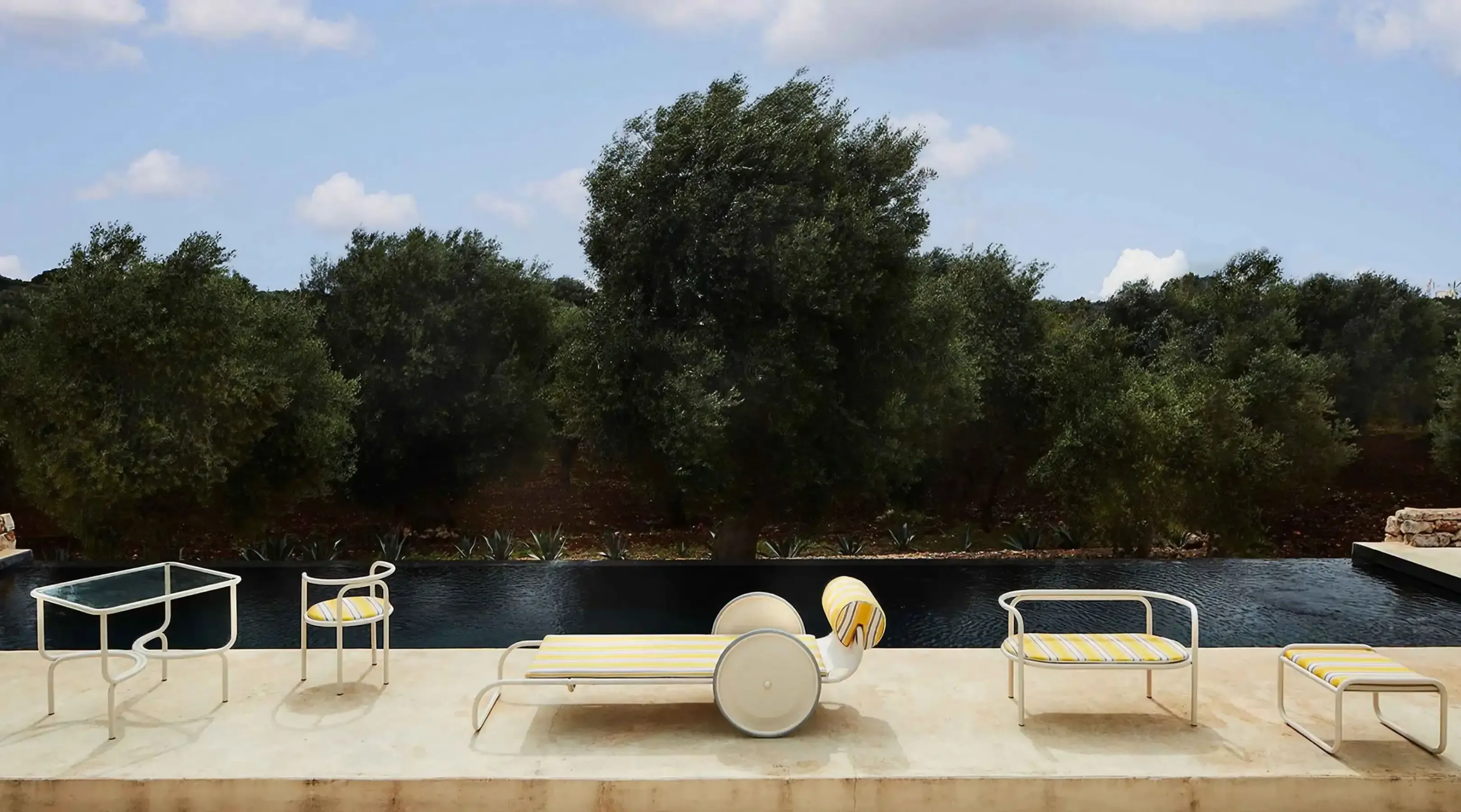
Locus Solus Sun Lounger - 1964
Brand:
Exteta
A tribute to 1960s Italian design, the Locus Solus Sun Lounger - 1964 by Gae Aulenti features oversized painted wheels that double as armrests and enhance mobility. Its stainless steel tubular frame is paired with handmade cushions in Exteta technical fabric, available in exclusive prints or custom colours. Bold, playful, and unmistakably retro.
Please contact us at custom-made@thecollectional.com to explore further.


A tribute to 1960s Italian design, the Locus Solus Sun Lounger - 1964 by Gae Aulenti features oversized painted wheels that double as armrests and enhance mobility. Its stainless steel tubular frame is paired with handmade cushions in Exteta technical fabric, available in exclusive prints or custom colours. Bold, playful, and unmistakably retro.
Please contact us at custom-made@thecollectional.com to explore further.
Gae Aulenti
Italian architect, designer, and editor
Gaetana "Gae" Emilia Aulenti was an Italian architect, designer, and editor. Being one of the few prominent female architects during her time, her implementation of individual expression and neo-libertarian ideologies in interior spaces made her an important figure in post-war Italian design.
Aulenti was born in Palazzolo dello Stella (in the Italian region of Friuli-Venezia Giulia) and remained close to her mother throughout her life. After being interested in contributing to the rebuilding of Italy, she studied architecture from the Politecnico di Milano in 1954, graduating as one of only two women in a class of twenty. She later went on to get married to alumni Francesco Buzzi.
In 1955, she joined Casabella-continuità and served as art director and graphic designer for a decade, where she continued to explore neo-liberty architectural theory. Aulenti's interpretation of this theory carries from the first piece of furniture - the Sgarsul chair - to her last work - the expansion of Perugia San Francesco d'Assisi Umbria International Airport which was inaugurated ten days after her passing.