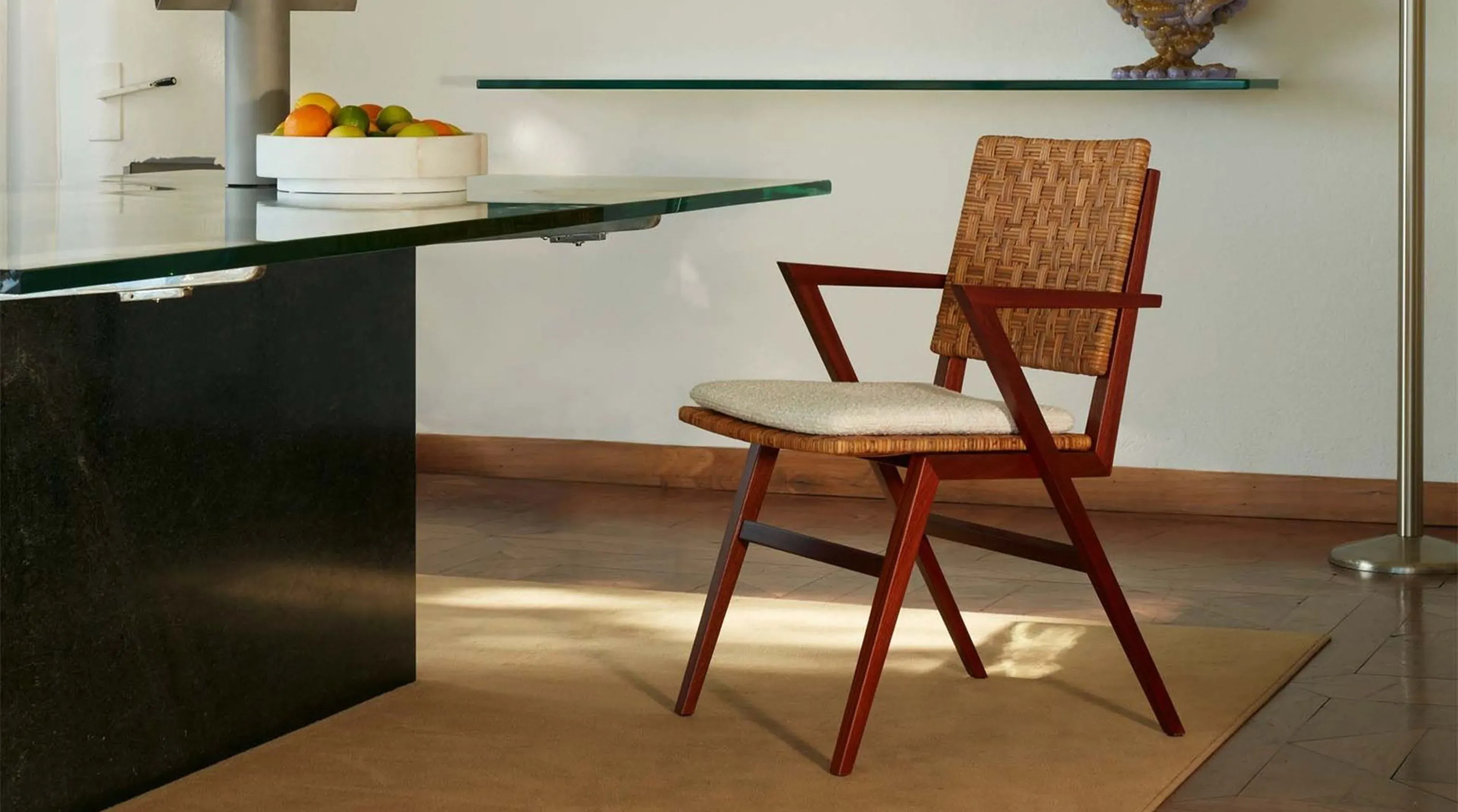
Sedia Lupo Dining Chair - 1945
Brand:
Exteta
The Sedia Lupo Armchair - 1945 by Franco Albini is a balance between sharp geometry and flowing form. Its silhouette is defined by angular lines, softened by gentle curves that echo the rhythm of waves. Woven wood fibers bring a texture, reminiscent of intricate embroidery.
Please contact us at custom-made@thecollectional.com to explore further.


The Sedia Lupo Armchair - 1945 by Franco Albini is a balance between sharp geometry and flowing form. Its silhouette is defined by angular lines, softened by gentle curves that echo the rhythm of waves. Woven wood fibers bring a texture, reminiscent of intricate embroidery.
Please contact us at custom-made@thecollectional.com to explore further.
Franco Albini
Italian architect, designer, and educator
Franco Albini, an Italian architect, designer, and educator whose understanding for material made him a defining figure in twentieth-century Italian modernism. He established new possibilities for how architecture, furniture and museum display could engage with both tradition and innovation.
Albini was born in Robbiate in the Lombardy region and began his professional career working in the office of Gio Ponti and Emilio Lancia. A year later, he opened his own practice and began exhibiting at the Milan Triennale. The architect Edoardo Persico saw Albini's early furnishings and called them "Novecentisti," a reference to the conservative movement then dominant in Italy. This critique set Albini on a trajectory toward embracing timeless silhouettes and functionality becoming one of the leading figures of the Milanese School.
Having served as co-director of Casabella for a brief period of time, Albini entered into a partnership with the architect Franca Helg that would last until his death, producing some of his most significant architectural and design work. Albini taught architecture and interior design at the Instituto Universitario di Architettura in Venice from 1949 to 1964 followed by a tenure at the Politecnico di Milano until his passing.